Vector Databases vs. Knowledge Graphs: Designing Long-Term Memory for AI Agents
Why traditional RAG pipelines fail in enterprise systems, and how combining Vector Databases with Knowledge Graphs builds deterministic long-term memory for AI agents.
When building autonomous AI agents for enterprise environments, the most critical architectural bottleneck is not the reasoning capability of the Large Language Model (LLM)—it is memory.
To bypass the physical token limits of the context window, developers rely on Retrieval-Augmented Generation (RAG). The standard approach is to chunk enterprise data, convert it into dense vector embeddings, and store it in a Vector Database (like Pinecone, Milvus, or Qdrant). When the agent asks a question, the system retrieves the most “semantically similar” text chunks and injects them into the prompt.
For simple Q&A bots, this architecture is sufficient. But for complex, multi-agent systems dealing with strict enterprise logic (like supply chain tracing, codebase refactoring, or audit compliance), pure Vector RAG inevitably fails.
This academic deep-dive explores the mathematical limitations of Vector Databases, the deterministic power of Knowledge Graphs (like Neo4j), and how modern AI architects are combining both to create a flawless GraphRAG memory pipeline.
1. The Mathematical Blind Spot of Vector Databases
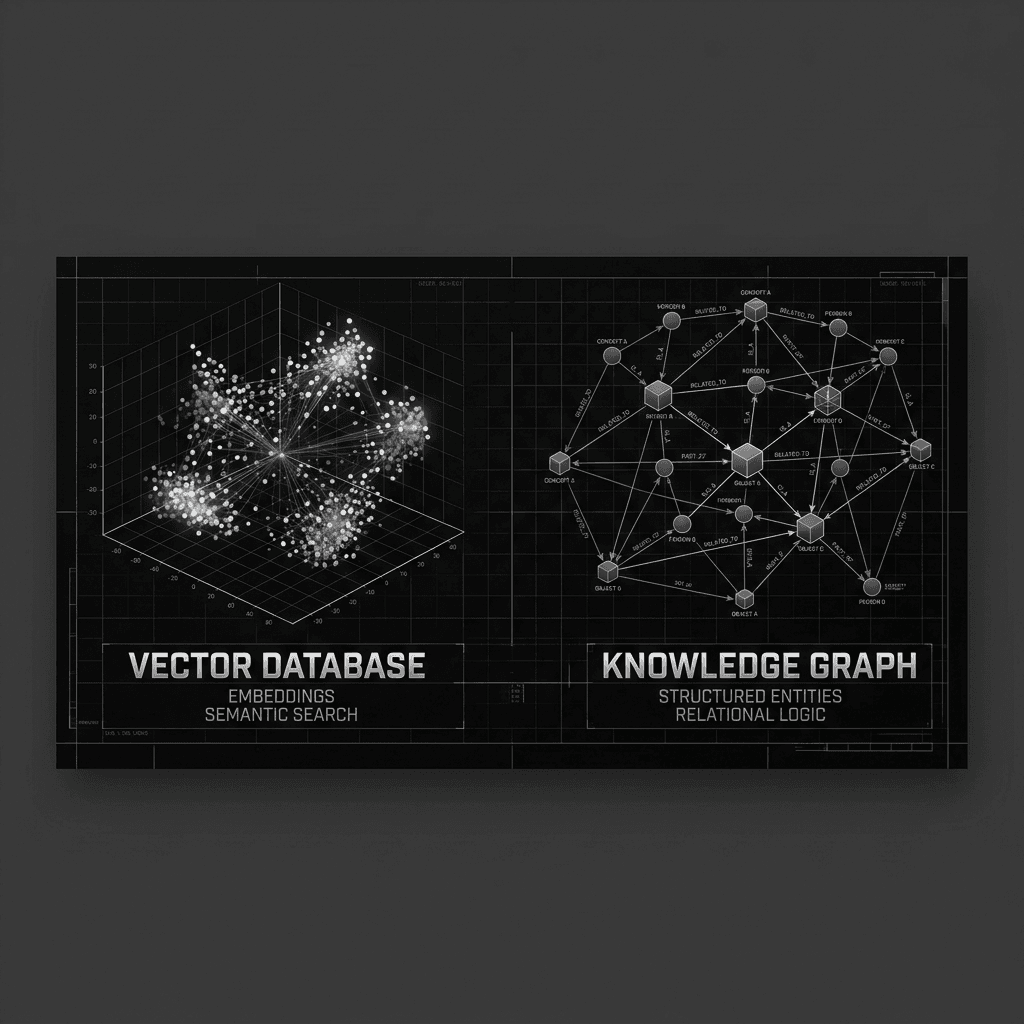
Vector Databases operate on the principle of Semantic Similarity. Text is mapped into high-dimensional space (e.g., 1536 dimensions for OpenAI’s text-embedding-3), and retrieval is calculated using metrics like Cosine Similarity or Euclidean Distance.
Where Vectors Succeed
Vectors are incredible at fuzzy matching and conceptual clustering. If an agent queries “How do I restart the primary server?”, the vector database can easily match it with a document titled “Rebooting the Main Production Node”, even though no keywords match exactly.
Where Vectors Fail (The “Lost Relationship” Problem)
Vectors have no concept of deterministic logic, hierarchy, or transitive relationships.
Imagine querying a pure vector database with this prompt:
“Find all the microservices that will fail if the Payment Gateway goes offline.”
The vector database will search for text chunks that semantically match “Payment Gateway” and “fail”. It might return a document explaining how the Payment Gateway was built, or an incident report about a past failure. It cannot traverse a dependency tree.
Because vector chunks are isolated floats in an abstract mathematical space, they completely destroy the relational structure of your enterprise data.
2. Enter Knowledge Graphs: Deterministic Relational Logic
A Knowledge Graph (KG) stores data not as isolated documents, but as explicit entities (Nodes) connected by specific relationships (Edges).
In a graph database, the data is stored exactly how it behaves in the real world:
[Microservice: Checkout]-(DEPENDS_ON)->[Microservice: Payment Gateway][Microservice: Payment Gateway]-(HOSTED_ON)->[Server: AWS-Node-04][Server: AWS-Node-04]-(MANAGED_BY)->[Engineer: Alice]
The Power of Graph Traversal
When an agent queries a Knowledge Graph with the same question (“What fails if the Payment Gateway goes offline?”), the database doesn’t guess based on semantic similarity. It performs a deterministic graph traversal (e.g., using Cypher query language) to instantly return every node connected by a DEPENDS_ON edge extending backwards from the Payment Gateway.
For enterprise AI agents, Knowledge Graphs provide:
- Explainability: You can mathematically prove exactly why a piece of data was retrieved.
- Infinite Context: Agents can traverse relationships infinitely deep without blowing up the token context window.
- Factual Accuracy: Hallucinations are mathematically impossible when data is retrieved via explicit graph edges.
3. The Ultimate Architecture: Hybrid GraphRAG
If Knowledge Graphs are so perfect, why do we use Vector Databases at all?
Because graphs are rigid. If your agent asks for “The Billing System” but your graph node is labeled “Payment Gateway”, a standard graph query will return nothing. Knowledge Graphs lack the fluid, natural language understanding that vectors excel at.
The solution used by top-tier AI architects is GraphRAG (Graph-Augmented Retrieval)—a hybrid architecture that leverages the strengths of both systems.
How GraphRAG Works in Production:
- Semantic Entry Point (Vector DB): When the agent receives a natural language query, it first hits the Vector Database. The vector search acts as a “fuzzy lens,” taking the ambiguous natural language and mapping it to the exact corresponding Node IDs in the Knowledge Graph.
- Deterministic Traversal (Graph DB): Once the precise entry nodes are identified, the system switches to the Knowledge Graph. It traverses the edges to pull all structured relationships, dependencies, and hierarchical data connected to those nodes.
- Context Injection: The highly structured graph data is converted into a structured schema (like JSON or Markdown tables) and injected into the LLM’s context window.
System Architecture Diagram
          [ Natural Language Query ]
          │
          ▼
┌──────────────────────┐
│  Vector Database     │  (Finds the closest semantic matches
│  (Fuzzy Search)      │   to identify the starting Nodes)
└─────────┬────────────┘
          │
      (Node IDs)
          │
          ▼
┌──────────────────────┐
│  Knowledge Graph     │  (Executes deterministic traversal
│  (Neo4j/Graph Traversal)│   to pull exact dependencies/relations)
└─────────┬────────────┘
          │
          ▼
[ Structured Context Injected to Agent ]
Conclusion
Relying exclusively on Vector Databases limits your AI agents to simple document-retrieval tasks. As you scale into autonomous, multi-agent systems orchestrating complex enterprise workflows, semantic similarity is no longer enough.
By implementing a GraphRAG architecture, you give your agents the best of both worlds: the fluid, fuzzy matching of Vector Embeddings combined with the mathematically deterministic, hallucination-free logic of Knowledge Graphs.
This is the architectural foundation of true AI long-term memory.