
The Mathematics of Transformer Architectures and Self-Attention
An academic analysis of the mathematical formulations and computational complexity behind Scaled Dot-Product Attention.
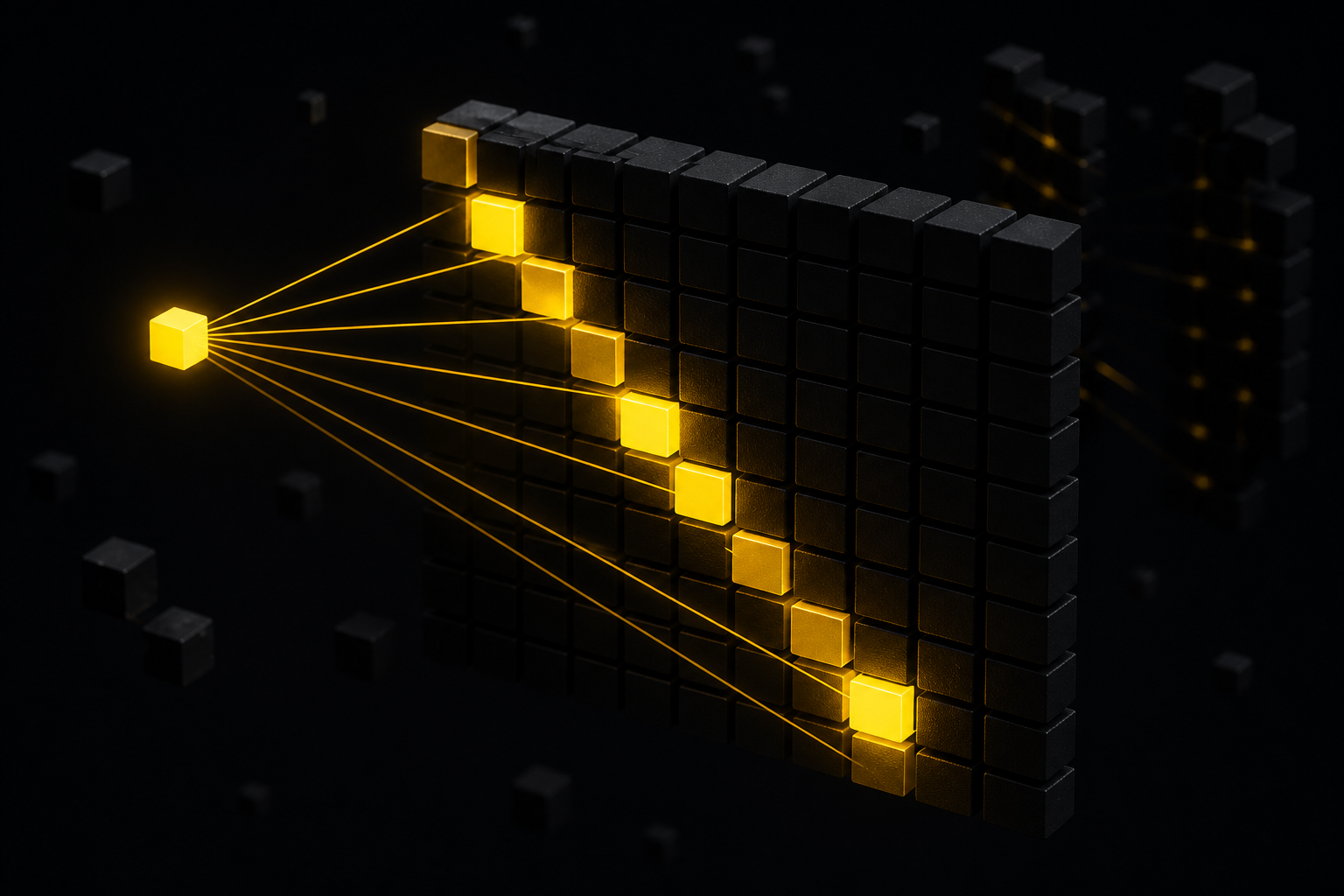
Modern generative artificial intelligence models (such as GPT, Llama, and Claude) all share a foundational architecture: the Transformer. Published in the seminal 2017 Google paper “Attention Is All You Need”, the core breakthrough of this architecture is the Attention mechanism. This mathematical structure allows models to compute contextual relationships between distant words dynamically, bypassing the sequential limitations of earlier network designs.
This academic paper analyzes the mathematical foundations of the Scaled Dot-Product Attention mechanism, reviews its variants (MHA, GQA, MQA), and evaluates computational complexity bounds, real-world failure modes, and hardware considerations for production environments.
1. Formal Mathematical Framework of Self-Attention
The attention mechanism processes input token embeddings by mapping them to three primary vector spaces:
- Query (Q): Represents the active search token requesting context.
- Key (K): Represents the keys of all tokens being searched against.
- Value (V): Represents the actual contextual content carried by each token.
Let the input sequence matrix be X, where X belongs to the real coordinate space R^(N x d_model). Here, N is the sequence length (the number of tokens in the context window) and d_model represents the embedding dimensionality of the model.
We compute the three vector spaces by multiplying X with learned projection weight matrices:
          Q = X * W_Q
K = X * W_K
V = X * W_V
Where the weight projection matrices have dimensions:
- W_Q belongs to R^(d_model x d_k)
- W_K belongs to R^(d_model x d_k)
- W_V belongs to R^(d_model x d_v)
This linear transformation maps the input representation into distinct mathematical subspaces, producing:
- Q belongs to R^(N x d_k)
- K belongs to R^(N x d_k)
- V belongs to R^(N x d_v)
Typically, in Multi-Head Attention configurations, d_k = d_v = d_model / h, where h is the number of active attention heads.
The core relationship between these three projected matrices is computed using the Scaled Dot-Product Attention formula:
Attention(Q, K, V) = softmax( (Q * K^T) / sqrt(d_k) ) * V
Detailed Mathematical Steps
- Query-Key Dot Product (Q * K^T): Computes raw dot-product similarity scores between every pair of query and key tokens, resulting in a matrix of shape N x N. A high dot product between query i and key j indicates that token i should strongly focus on token j.
- Dimension Scaling (1 / sqrt(d_k)): Scales the raw similarity scores by the square root of the key dimension. This scaling factor prevents the softmax function from saturating in high-dimensional spaces.
- Softmax Normalization: Converts scaled dot-product similarity scores into a probability distribution (ranging between 0 and 1) along each row:
This row-wise normalization yields the N x N attention weight matrix A, representing the dynamic attention distribution.
A[i, j] = exp( (q[i] * k[j]^T) / sqrt(d_k) ) / [ sum over l of exp( (q[i] * k[l]^T) / sqrt(d_k) ) ] - Weighted Value Summation (A * V): Multiplies the attention weight matrix A with the Value matrix V. The output is a matrix of size N x d_v, where the representation of each token is a weighted linear combination of all token values based on their semantic relevance.
The Mathematical Proof: Why Divide by sqrt(d_k)?
To understand why scaling is critical, we examine the behavior of high-dimensional dot products. Suppose we have a query vector q and a key vector k of dimension d_k. Assume that their components q_m and k_m are independent random variables, each with a mean of 0 and a variance of 1:
          E[q_m] = E[k_m] = 0
Var(q_m) = Var(k_m) = 1
The dot product of these two vectors is defined as:
dot(q, k) = sum over m=1 to d_k of (q_m * k_m)
The expected value (mean) of their dot product is:
          E[dot(q, k)] = sum over m=1 to d_k of E[q_m * k_m]
             = sum over m=1 to d_k of (E[q_m] * E[k_m])
             = 0
Since the components are independent, the variance of their dot product is the sum of the variances of individual component products:
Var(dot(q, k)) = sum over m=1 to d_k of Var(q_m * k_m)
For two independent random variables A and B with zero mean:
          Var(A * B) = E[(A * B)^2] - (E[A * B])^2
           = E[A^2] * E[B^2] - 0
           = (Var(A) + E[A]^2) * (Var(B) + E[B]^2)
Given that Var(q_m) = Var(k_m) = 1 and their means are 0:
Var(q_m * k_m) = (1 + 0) * (1 + 0) = 1
Summing this variance over all d_k dimensions:
Var(dot(q, k)) = sum over m=1 to d_k of 1 = d_k
Thus, the variance of the raw dot product scales linearly with the dimensionality d_k. For a typical dimension size of d_k = 128, the variance of the dot product is 128, leading to standard deviations of approximately 11.3.
When values of this magnitude are passed to the softmax function, the largest value dominates, pushing the softmax function into regions where its derivative is extremely close to zero. This leads to vanishing gradients during backpropagation. Dividing the dot product by sqrt(d_k) scales the variance back to 1:
Var( dot(q, k) / sqrt(d_k) ) = Var(dot(q, k)) / d_k = d_k / d_k = 1
This simple scaling mathematically preserves gradient flow, ensuring stable convergence.
Concrete Walkthrough: Step-by-Step 2x2 Matrix Calculation
Let us trace these operations with a concrete, numerical example. Consider a sequence of N = 2 tokens processed with query/key dimension d_k = 2 and value dimension d_v = 2.
Let the projected matrices Q, K, and V be:
          Query (Q) = [ [ 1.0,  2.0 ],
              [ 0.0, -1.0 ] ]

Key (K)   = [ [ 2.0,  0.0 ],
              [ 1.0,  1.0 ] ]

Value (V) = [ [ 10.0, 20.0 ],
              [ 30.0, 40.0 ] ]
Step 1: Raw Dot Product (Q * K^T)
First, we transpose matrix K:
          K^T = [ [ 2.0, 1.0 ],
        [ 0.0, 1.0 ] ]
Now we compute the matrix multiplication S = Q * K^T:
          S[1, 1] = (1.0 * 2.0) + (2.0 * 0.0)  = 2.0
S[1, 2] = (1.0 * 1.0) + (2.0 * 1.0)  = 3.0
S[2, 1] = (0.0 * 2.0) + (-1.0 * 0.0) = 0.0
S[2, 2] = (0.0 * 1.0) + (-1.0 * 1.0) = -1.0

S = [ [ 2.0,  3.0 ],
      [ 0.0, -1.0 ] ]
Step 2: Scale by sqrt(d_k)
Since d_k = 2, the scaling factor is sqrt(2) ≈ 1.4142:
          S_scaled = S / 1.4142

S_scaled[1, 1] = 2.0 / 1.4142 ≈ 1.414
S_scaled[1, 2] = 3.0 / 1.4142 ≈ 2.121
S_scaled[2, 1] = 0.0 / 1.4142 = 0.0
S_scaled[2, 2] = -1.0 / 1.4142 ≈ -0.707

S_scaled = [ [ 1.414,  2.121 ],
             [ 0.000, -0.707 ] ]
Step 3: Row-Wise Softmax Normalization
We apply the softmax function to each row.
Row 1:
- Exponents:
exp(1.414) ≈ 4.112andexp(2.121) ≈ 8.339 - Sum:
4.112 + 8.339 = 12.451 - Probabilities:
A[1, 1] = 4.112 / 12.451 ≈ 0.330A[1, 2] = 8.339 / 12.451 ≈ 0.670
Row 2:
- Exponents:
exp(0.000) = 1.000andexp(-0.707) ≈ 0.493 - Sum:
1.000 + 0.493 = 1.493 - Probabilities:
A[2, 1] = 1.000 / 1.493 ≈ 0.670A[2, 2] = 0.493 / 1.493 ≈ 0.330
This yields the Attention Weight Matrix A:
          A = [ [ 0.330, 0.670 ],
      [ 0.670, 0.330 ] ]
Step 4: Multiply by Value Matrix (A * V)
Finally, we multiply A by V:
          A * V = [ [ 0.330, 0.670 ],     *   [ [ 10.0, 20.0 ],
          [ 0.670, 0.330 ] ]          [ 30.0, 40.0 ] ]

Output[1, 1] = (0.330 * 10.0) + (0.670 * 30.0) = 3.30 + 20.10 = 23.40
Output[1, 2] = (0.330 * 20.0) + (0.670 * 40.0) = 6.60 + 26.80 = 33.40
Output[2, 1] = (0.670 * 10.0) + (0.330 * 30.0) = 6.70 + 9.90  = 16.60
Output[2, 2] = (0.670 * 20.0) + (0.330 * 40.0) = 13.40 + 13.20 = 26.60

Output = [ [ 23.40, 33.40 ],
           [ 16.60, 26.60 ] ]
This outputs our fully contextualized token representation matrix.
2. Multi-Head, Multi-Query, and Grouped-Query Attention
Modern LLM architectures adapt standard self-attention to optimize parameter representations and memory bandwidth. We analyze the three primary paradigms:
A. Multi-Head Attention (MHA)
Rather than performing a single attention function with dimensional queries, keys, and values, MHA projects them h times into separate representation subspaces. Each head performs dot-product attention in parallel:
          MHA(Q, K, V) = Concat(head[1], ..., head[h]) * W_O
where head[i] = Attention(Q * W_Q[i], K * W_K[i], V * W_V[i])
- Pros: Learns distinct types of relationships across different heads (e.g., syntactical vs. semantic).
- Cons: High memory footprint, as h sets of Key and Value vectors must be stored in GPU memory during generation.
B. Multi-Query Attention (MQA)
Multi-Query Attention simplifies MHA by using only a single key and value head shared across all h query heads.
- Pros: Drastically reduces KV cache memory consumption.
- Cons: Can lead to capacity loss and lower accuracy on complex semantic tasks.
C. Grouped-Query Attention (GQA)
Grouped-Query Attention acts as a hybrid. It groups query heads into g groups, with each group sharing a single KV head.
- Pros: Recovers almost all of the accuracy of MHA while achieving inference throughput similar to MQA.
            [ Multi-Head Attention (MHA) ]           [ Grouped-Query Attention (GQA) ]          [ Multi-Query Attention (MQA) ]
  Q Heads:   K Heads:   V Heads:           Q Heads:   K Heads:   V Heads:            Q Heads:   K Heads:   V Heads:
  [Q1]-----> [K1]-----> [V1]               [Q1]---\                                  [Q1]---\
  [Q2]-----> [K2]-----> [V2]               [Q2]----+-> [K1]-----> [V1]               [Q2]----+
  [Q3]-----> [K3]-----> [V3]               [Q3]---/                                  [Q3]----+-> [K1]-----> [V1]
  [Q4]-----> [K4]-----> [V4]               [Q4]---\                                  [Q4]----+
  [Q5]-----> [K5]-----> [V5]               [Q5]----+-> [K2]-----> [V2]               [Q5]----+
  [Q6]-----> [K6]-----> [V6]               [Q6]---/                                  [Q6]---/
  (1-to-1 ratio for all heads)             (Grouped ratio, e.g., 3-to-1)             (Many-to-1 ratio, all share 1 KV)
3. Computational Complexity and KV Cache Scaling Bounds
While sequential recurrent models (LSTMs) scale linearly with sequence length O(N), self-attention scales quadratically O(N^2) due to the token-to-token similarity comparisons.
FLOP Analysis of a Single Self-Attention Layer
For a model with sequence length N and hidden dimension d_model:
- QKV Projection: Projects the input to Q, K, and V. Requires
3 * (2 * N * d_model^2) = 6 * N * d_model^2FLOPs. - Similarity Matrix (Q * K^T): Computes similarity of size
N x Nwith vectors of sized_model. Requires2 * N^2 * d_modelFLOPs. - Softmax: Row-wise exponentiation and normalization. Operational complexity scales as
O(N^2). - Attention Accumulation (A * V): Multiplies the
N x Nweight matrix by theN x d_modelvalue matrix. Requires2 * N^2 * d_modelFLOPs. - Output Projection: Projects back to the hidden state. Requires
2 * N * d_model^2FLOPs.
The total computational footprint of a self-attention layer is:
Total FLOPs ≈ 8 * N * d_model^2 + 4 * N^2 * d_model
As the sequence length N increases, the quadratic term 4 * N^2 * d_model dominates, explaining why long-context processing requires massive computational resources.
Quantitative Complexity Chart
Below is a representation of how sequence length impacts floating-point operations (FLOPs) and KV Cache memory consumption for a model with d_model = 4096, 32 layers, and 32 attention heads:
| Sequence Length (N) | Matrix Multiply FLOPs (Q * K^T + A * V) | KV Cache Memory per Token (FP16) | Total KV Cache Size (Batch Size = 1) |
|---|---|---|---|
| 512 | 1.05 * 10^9 FLOPs | 32 KB / token | 16.0 MB |
| 2,048 | 1.68 * 10^10 FLOPs | 32 KB / token | 64.0 MB |
| 8,192 | 2.68 * 10^11 FLOPs | 32 KB / token | 256.0 MB |
| 32,768 | 4.29 * 10^12 FLOPs | 32 KB / token | 1.02 GB |
| 131,072 | 6.87 * 10^13 FLOPs | 32 KB / token | 4.10 GB |
The KV Cache memory footprint is computed using the following equation:
Memory_KVCache (Bytes) = 2 * BatchSize * SequenceLength * LayerCount * HeadCount_KV * HeadDim * PrecisionBytes
Under FP16 precision (2 bytes), a batch size of 16 running a context window of 32,768 tokens consumes over 16 GB of memory just to store the key-value states, introducing major memory bottlenecks in production.
4. Edge Cases and Production Failure Modes
In production systems, several physical and mathematical failure modes emerge when scaling self-attention.
A. Vanishing/Exploding Gradients in Softmax
As discussed, when dot products q[i] * k[j]^T become large, softmax maps them to values close to 0 or 1. The derivative of softmax is:
d(softmax(x)_i) / d(x_j) = softmax(x)_i * (delta_ij - softmax(x)_j)
When softmax(x)_i is highly polarized (close to 0 or 1), the derivative approaches 0 for all elements. This halts backpropagation through the Query and Key projection weights, preventing the model from learning long-range dependencies.
B. Token Context Saturation (Attention Sinks)
As sequence lengths exceed the pretraining context window, the model’s perplexity can degrade exponentially. Research reveals that self-attention layers exhibit an “attention sink” phenomenon: they allocate a massive portion of attention weights (often >50%) to the absolute first token (index 0), even if that token is a semantically empty delimiter (like <s> or [CLS]).
Softmax requires all attention weights to sum to 1. The model uses the first token as a dump or placeholder for attention weights when no other tokens are semantically relevant. Removing or truncating this first token during generation breaks the self-attention mechanism, causing immediate model collapse.
C. Hardware Memory Bandwidth Stalls
A common mistake is assuming that GPU utilization in LLMs is bottlenecked by raw arithmetic performance (TFLOPS). In reality, self-attention layers are heavily bottlenecked by memory bandwidth.
GPU processing consists of two stages:
- Compute-bound operations: Large matrix multiplications (GEMMs) executed efficiently on Tensor Cores.
- Memory-bound operations: Softmax, scaling, dropout, causal masking, and element-wise additions.
These memory-bound operations require reading matrices from High Bandwidth Memory (HBM) into GPU on-chip SRAM, performing computations, and writing them back to HBM. In long-context scenarios, the GPU cores sit idle, waiting for the memory bus to complete these transfers.
This memory bottleneck led to the creation of FlashAttention, which uses tiling strategies to calculate the softmax reduction incrementally without writing large intermediate N x N similarity matrices back to HBM.
D. Attention Decay over Distance
Dot-product attention does not naturally incorporate token order; it is permutation-invariant. Modern positional embeddings have different scaling limits:
- Sinusoidal Position Embeddings: Degrade when processing sequences longer than those seen during training.
- Rotary Position Embedding (RoPE): Rotates the query and key vectors in complex 2D planes to encode relative distance. However, RoPE still suffers from attention decay when extrapolating to extremely long context windows.
- ALiBi (Attention with Linear Biases): Subtracts a constant penalty proportional to token distance directly from the raw dot-product scores:
This mathematically guarantees exponential decay of attention over distance, enabling zero-shot context length scaling.
AttentionWeight = softmax( (Q * K^T) / sqrt(d_k) - m * distance )
5. Performance, Memory, and Cost Optimization Strategies
Optimizing self-attention is essential for cost-effective enterprise deployments.
A. FlashAttention Tiling
FlashAttention restructures the attention computation by dividing the Query, Key, and Value matrices into blocks (tiles) that fit within the GPU’s fast SRAM memory. By utilizing online softmax, it computes attention increments block-by-block, reducing memory access overhead from O(N^2) to O(N). FlashAttention-2 and FlashAttention-3 build on this by scheduling warps efficiently and overlapping computation with memory prefetching.
B. Precision Quantization (FP16, BF16, INT8, INT4)
Downscaling precision reduces memory requirements but introduces numerical stability challenges:
- FP16 (Float16): Limited dynamic range (5 exponent bits, 10 mantissa bits). It is prone to underflow and overflow when scaling large attention scores.
- BF16 (BFloat16): Larger dynamic range (8 exponent bits, 7 mantissa bits, matching FP32). Highly recommended for training and fine-tuning to prevent numerical overflows in attention projections.
- INT8/INT4 Quantization: Quantizing activation matrices can cause quality loss due to “outlier channels”—activation coordinates with values up to 100x the average. Advanced algorithms like SmoothQuant and AWQ scale activations to mitigate quantization errors in attention layers.
Running large-scale AI math models, running local tests, and parsing massive datasets requires reliable VPS hosting environments with dedicated virtual resources.
Hostinger VPS Server Hosting
High-performance, isolated VPS server configurations providing dedicated CPU and RAM resources ideal for testing AI models and mathematical scripts.
C. Economic Analysis: Cloud Clusters vs. Dedicated VPS Solutions
Deploying large-scale models in public clouds can become expensive. Below is an economic comparison of running inference workloads on public cloud clusters vs. optimized VPS solutions:
| Metric | Public Cloud Cluster (e.g., 8x H100) | Private High-Performance VPS Cluster |
|---|---|---|
| Monthly Cost | 28,000 | 1,500 |
| KV Cache Performance | Maximum (via specialized HBM3) | High (optimized CPU-offload and RAM) |
| Ideal Workloads | Massive, continuous multi-user API | Fine-tuning, batch processing, local testing |
| Control & Isolation | Shared resources / Virtualized | Fully isolated dedicated resources |
For early-stage testing, mathematical exploration, or structured batch inference, a dedicated VPS configuration provides a cost-effective alternative to public cloud instances.
6. Step-by-Step Enterprise Implementation Blueprint
Below is a complete, functional PyTorch implementation of an optimized Self-Attention module that supports Grouped-Query Attention (GQA), causal masking, and KV-Caching:
          import torch
import torch.nn as nn
import math

class OptimizedSelfAttention(nn.Module):
    def __init__(self, d_model, num_heads, num_kv_heads=None):
        super().__init__()
        self.d_model = d_model
        self.num_heads = num_heads
        # Support Grouped-Query Attention (GQA)
        self.num_kv_heads = num_kv_heads if num_kv_heads is not None else num_heads

        self.head_dim = d_model // num_heads
        self.kv_group_size = num_heads // self.num_kv_heads

        assert d_model % num_heads == 0, "d_model must be divisible by num_heads"
        assert num_heads % self.num_kv_heads == 0, "num_heads must be divisible by num_kv_heads"

        # Projection weights
        self.q_proj = nn.Linear(d_model, num_heads * self.head_dim, bias=False)
        self.k_proj = nn.Linear(d_model, self.num_kv_heads * self.head_dim, bias=False)
        self.v_proj = nn.Linear(d_model, self.num_kv_heads * self.head_dim, bias=False)
        self.out_proj = nn.Linear(num_heads * self.head_dim, d_model, bias=False)

    def forward(self, x, mask=None, kv_cache=None):
        """
        Args:
            x (torch.Tensor): Shape (batch_size, seq_len, d_model)
            mask (torch.Tensor, optional): Shape (batch_size, 1, seq_len, target_seq_len)
            kv_cache (dict, optional): Dict containing key-value states:
                                       {'key': prev_k, 'value': prev_v}
        Returns:
            output (torch.Tensor): Shape (batch_size, seq_len, d_model)
            kv_cache (dict): Updated key-value cache
        """
        b_size, seq_len, _ = x.shape

        # 1. Project inputs to Q, K, V spaces
        q = self.q_proj(x) # (B, N, num_heads * head_dim)
        k = self.k_proj(x) # (B, N, num_kv_heads * head_dim)
        v = self.v_proj(x) # (B, N, num_kv_heads * head_dim)

        # 2. Reshape tensors for multi-head calculation
        # Q: (B, num_heads, N, head_dim)
        q = q.view(b_size, seq_len, self.num_heads, self.head_dim).transpose(1, 2)
        # K, V: (B, num_kv_heads, N, head_dim)
        k = k.view(b_size, seq_len, self.num_kv_heads, self.head_dim).transpose(1, 2)
        v = v.view(b_size, seq_len, self.num_kv_heads, self.head_dim).transpose(1, 2)

        # 3. Process KV Cache
        if kv_cache is not None:
            if 'key' in kv_cache and kv_cache['key'] is not None:
                # Concatenate along target sequence dimension
                k = torch.cat([kv_cache['key'], k], dim=2)
                v = torch.cat([kv_cache['value'], v], dim=2)
            kv_cache['key'] = k
            kv_cache['value'] = v

        target_seq_len = k.shape[2]

        # 4. Broadcast KV heads for GQA groups
        if self.kv_group_size > 1:
            k = k.repeat_interleave(self.kv_group_size, dim=1)
            v = v.repeat_interleave(self.kv_group_size, dim=1)

        # 5. Compute raw similarity scores
        # scores: (B, num_heads, seq_len, target_seq_len)
        scores = torch.matmul(q, k.transpose(-2, -1)) / math.sqrt(self.head_dim)

        # 6. Apply masking
        if mask is not None:
            scores = scores.masked_fill(mask == 0, float('-inf'))

        # 7. Apply softmax
        attn_weights = torch.softmax(scores, dim=-1)

        # 8. Weight Values
        # context: (B, num_heads, seq_len, head_dim)
        context = torch.matmul(attn_weights, v)

        # 9. Reshape and project output
        context = context.transpose(1, 2).contiguous().view(b_size, seq_len, -1)
        output = self.out_proj(context)

        return output, kv_cache
Autoregressive Production Pipeline Design
To deploy this module in an autoregressive text generation pipeline, use the blueprint below:
          # Deployment setup
device = torch.device("cuda" if torch.cuda.is_available() else "cpu")
attention_layer = OptimizedSelfAttention(d_model=4096, num_heads=32, num_kv_heads=8).to(device)

# Initialize KV Cache dictionary
kv_cache = {"key": None, "value": None}

# Input sequence generation simulation
batch_size = 1
vocab_size = 32000
embeddings = nn.Embedding(vocab_size, 4096).to(device)

# Step A: Prefill phase (processes initial prompt tokens)
prompt_tokens = torch.tensor([[101, 2341, 1002, 5403]]).to(device) # Shape: (1, 4)
prompt_emb = embeddings(prompt_tokens) # Shape: (1, 4, 4096)

# Create causal mask for prefill
seq_len = prompt_tokens.shape[1]
mask = torch.tril(torch.ones(seq_len, seq_len)).view(1, 1, seq_len, seq_len).to(device)

# Forward pass
output, kv_cache = attention_layer(prompt_emb, mask=mask, kv_cache=kv_cache)
print("Prefill KV Cache Key shape:", kv_cache["key"].shape)
# Expected Shape: (1, 8, 4, 128) - Batch, KV Heads, SeqLen, HeadDim

# Step B: Autoregressive decoding phase (generates next tokens sequentially)
next_token = torch.tensor([[5543]]).to(device) # Shape: (1, 1)
for step in range(5):
    next_emb = embeddings(next_token) # Shape: (1, 1, 4096)

    # In decoding, new token attends to all cached tokens. No causal masking required
    output, kv_cache = attention_layer(next_emb, mask=None, kv_cache=kv_cache)

    # Select next token using argmax or top-k sampling (simulated)
    next_token = torch.tensor([[1234 + step]]).to(device)

print("Final KV Cache Key shape:", kv_cache["key"].shape)
# Expected Shape: (1, 8, 9, 128) - 4 original + 5 newly generated tokens
Conclusion
The success of the Transformer architecture lies in its ability to compute semantic relationships dynamically using parallel matrix operations. While the quadratic O(N^2) scaling presents memory bandwidth and storage challenges, optimizations like GQA, FlashAttention, and private high-performance VPS clusters make it possible to run these models efficiently in production.
Understanding the underlying mathematics enables developers to design robust architectures, deploy stable models, and optimize infrastructure costs.