
The Rise of Open-Weight Models: Self-Hosting and Fine-Tuning
The reasons behind the massive migration in AI infrastructure from closed APIs to self-hosting and fine-tuning processes.
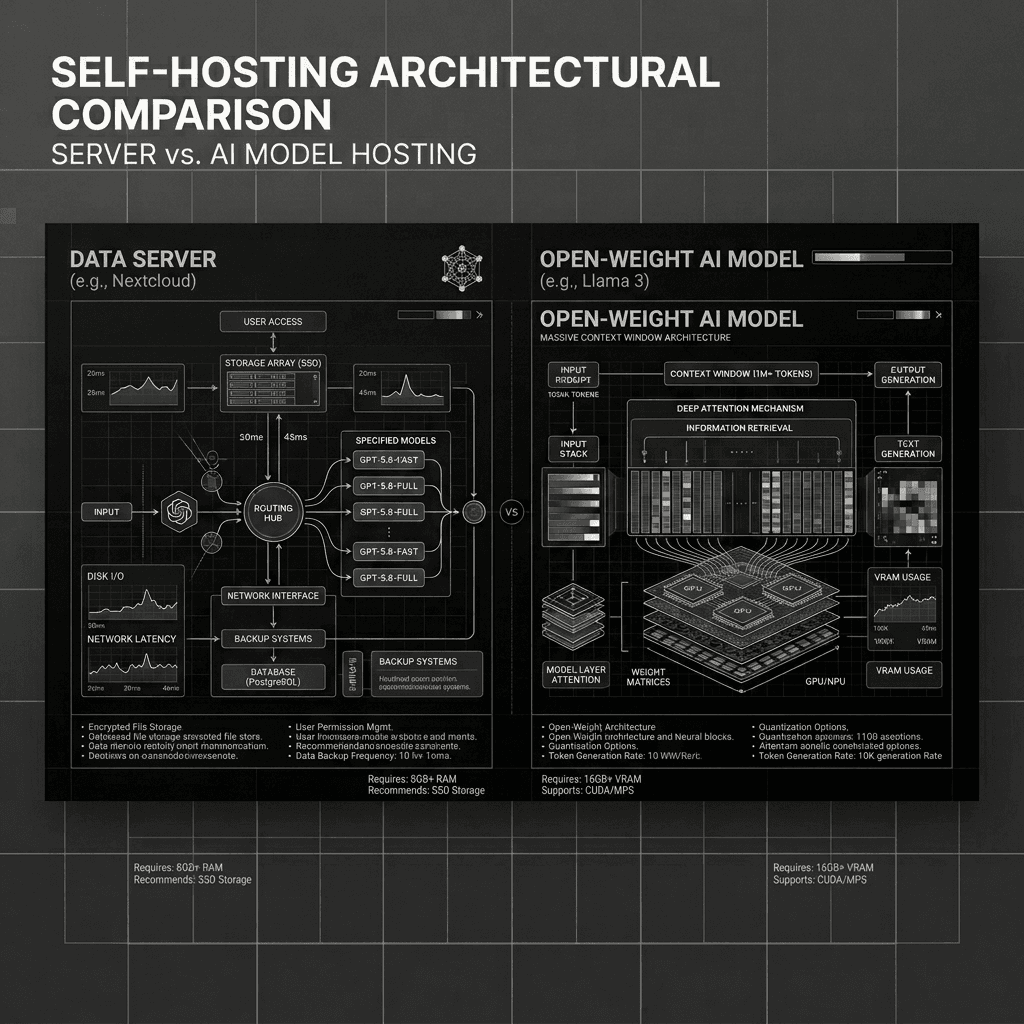
In mid-2026, the biggest paradigm shift in the AI world is the massive migration from closed API services to open-weight infrastructures. Open models are no longer just for “hobbyists”; they have become the enterprise infrastructure itself.
1. Performance Parity and the Definition Shift
The perception that “proprietary models are always better” has been completely shattered. Open models published by labs like Meta, Mistral, DeepSeek, and Z.ai (e.g., GLM-5.2, Kimi K2.7, MiniMax M3) are now matching, and sometimes outperforming, the flagship models of OpenAI and Anthropic in coding and logical reasoning benchmarks.
The industry has also clarified the distinction between “Open Source” (fully open training data, code, and weights) and “Open-Weight” (only model weights are publicly available), and the current revolution is being driven by Open-Weight models.
2. The Self-Hosting Revolution: Data Sovereignty
There are two main reasons why organizations no longer want to rely on external APIs: Security and Cost.
- Data Sovereignty: Companies refuse to send their proprietary code, customer data, or financial reports to 3rd party APIs. By running the model on their own servers (Self-hosting), they ensure all data stays within the corporate firewall.
- Cost (TCO): Although the initial capital expenditure (CapEx) of setting up a private GPU cluster is high, the total cost of ownership (TCO) for high-volume operations is significantly lower compared to the recurring per-token fees paid to API providers (typically amortized in 12-18 months).
- Infrastructure Maturity: In 2026, deploying your own model on a server is no longer a nightmare. Thanks to standardized open-source infrastructure tools like vLLM, Ollama, SGLang, and Docker, setting up your own LLM server has become as easy as setting up a standard web server.
3. Fine-Tuning: The New Industry Standard
Model training, once a task exclusively for machine learning PhD students, has now evolved into a standard engineering practice.
- Accessibility: Thanks to Parameter-Efficient methods like LoRA and QLoRA, even massive models can be trained on consumer-grade computers (e.g., with a few RTX 4090 or 5090 GPUs) in days or even hours to adapt to the organization’s own language, coding standards, or specific tasks.
- Tooling Ecosystem: Libraries like Unsloth and Axolotl have incredibly accelerated and standardized the fine-tuning processes.
- Strategic Usage: Companies now know exactly when to Fine-Tune models and when to use RAG (Retrieval-Augmented Generation). Fine-tuning is used for the company’s writing style, coding architecture, and core reflexes, whereas RAG architectures are preferred for constantly changing real-time data.
Conclusion
In July 2026, companies are positioning AI models not as externally rented “services,” but as strategic infrastructure components—just like databases or server infrastructures—hosted in-house, customized with their own data, and completely under their control.