
Enterprise LLM Routing: GPT-5.6 vs Claude Opus 4.8
A production-grade architectural analysis comparing OpenAI's newly announced GPT-5.6 series with Anthropic's Claude Opus 4.8, focusing on routing strategies, latency, and context depth.
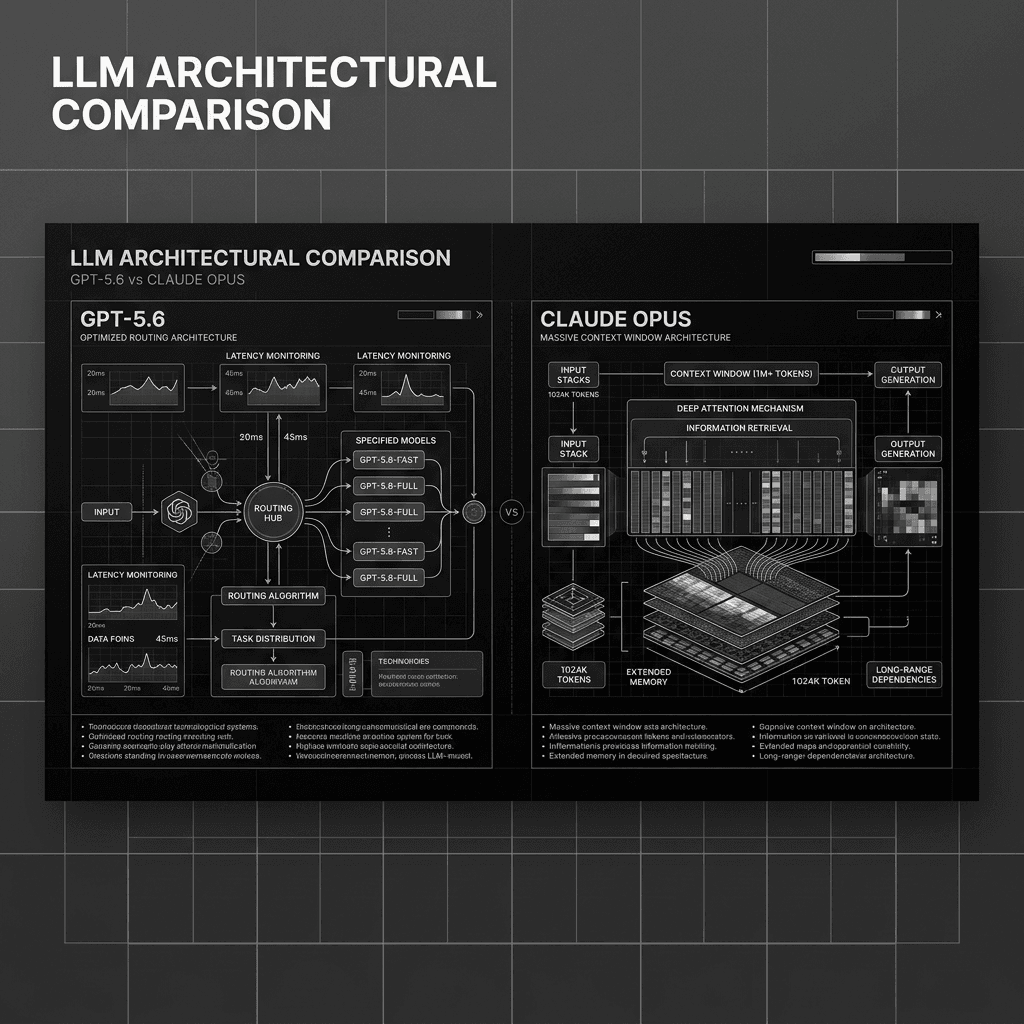
On June 26, 2026, OpenAI officially announced the GPT-5.6 model family. While generic benchmarks dominate the timelines, the real question for system architects is how this new architecture holds up in production environments—specifically when compared to Anthropic’s heavy-hitter, Claude Opus 4.8.
In enterprise AI, relying on a single foundation model is an anti-pattern. Building cost-effective, low-latency multi-agent systems requires a hybrid routing architecture.
This technical deep-dive breaks down the specific capabilities of the new GPT-5.6 lineup, compares them against Claude Opus 4.8, and provides a deterministic decision matrix for enterprise routing.
1. The GPT-5.6 Architecture: Speed and Granular Control
Unlike previous iterations, OpenAI has fragmented the GPT-5.6 release into three distinct tiers optimized for different computational workloads: Sol, Terra, and Luna.
The Three Tiers
- GPT-5.6 Luna: Optimized purely for Time-To-First-Token (TTFT) and high-throughput structured data extraction. It is the cheapest and fastest variant.
- GPT-5.6 Terra: The enterprise workhorse. It achieves parity with GPT-5.5 but at a fraction of the inference cost, making it ideal for standard RAG pipelines.
- GPT-5.6 Sol: The flagship reasoning engine. Sol introduces an entirely new inference paradigm for complex system design and scientific reasoning.
Key Innovations in GPT-5.6
OpenAI has introduced two critical programmatic controls in the GPT-5.6 Sol API that drastically alter how developers orchestrate autonomous agents:
- Max Reasoning Effort: Developers can now programmatically define the computational budget (in tokens) the model is allowed to spend “thinking” before returning a final output. This prevents infinite reasoning loops while allowing deep logic trees for critical tasks.
- Ultra Mode (Subagent Orchestration): Sol natively supports spawning background “subagents.” For a massive task, the model automatically parallelizes execution across multiple smaller contexts and synthesizes the final result, shifting orchestration overhead from your backend directly to OpenAI’s infrastructure.
2. Claude Opus 4.8: The Absolute Context Heavyweight
While OpenAI has optimized for agentic routing and granular compute control, Anthropic’s Claude Opus 4.8 remains the undisputed king of absolute fidelity and massive context windows.
Zero-Shot Architectural Mastery
Opus 4.8 does not compete in the sub-50ms latency war. Instead, it is engineered for scenarios where context loss is catastrophic. With a near-flawless extended context window, Opus 4.8 excels at:
- Full-Codebase Refactoring: Ingesting 50+ files of a monolithic repository and generating a zero-shot migration plan to microservices without losing track of obscure dependency graphs.
- Deep Systemic Debugging: Synthesizing thousands of lines of raw server logs to identify race conditions that smaller models simply hallucinate over.
If GPT-5.6 is your rapid-response tactical team, Claude Opus 4.8 is your lead enterprise architect.
3. The Production Decision Matrix
To build a commercially viable agent platform, you must route tasks based on the specific physics of the prompt. Relying exclusively on GPT-5.6 Sol or Opus 4.8 will burn through your token budget instantly.
Here is the deterministic routing matrix we use at Canary:
🟢 Route to GPT-5.6 (Luna/Terra)
- Real-Time Synchronous Execution: Any task that blocks the user UI (e.g., chat autocomplete, instant JSON extraction).
- Agentic Decision Trees: The orchestration layer. Use Luna to quickly decide which tool to call, parse the output, and decide the next step.
- Cost-Sensitive RAG: Standard document retrieval where the context is neatly chunked and filtered.
🟣 Route to Claude Opus 4.8
- Massive Context Synthesis: Tasks where the prompt exceeds 100k tokens and requires 100% recall accuracy.
- Complex Code Generation: When building entirely new features from scratch that require deep understanding of multiple overlapping frameworks.
- Legal & Compliance Audits: Scrutinizing massive audit trails where hallucinating a single variable is a critical failure.
🔴 Route to GPT-5.6 Sol (Ultra Mode)
- Asynchronous Deep Reasoning: Scientific analysis, complex cybersecurity threat modeling, or any long-running task where you can utilize the
Max Reasoning Effortbudget and let the model spawn subagents in the background.
Conclusion
The release of GPT-5.6 solidifies the need for dynamic model routing. Anthropic’s Claude Opus 4.8 provides the deep, flawless context required for heavy architectural synthesis, while OpenAI’s new tiered system provides the ultra-low latency and granular compute controls needed for rapid agentic execution.
By aligning your LLM invocations with their underlying mathematical strengths, you can build enterprise-grade AI systems that operate at peak reasoning performance while maintaining strict budget constraints.