Enterprise RAG Architectures: Combining the Power of Vectors and Knowledge Graphs
The challenges companies face when training LLMs on their own data, and how Hybrid RAG systems (Vector + Graph) solve these problems deterministically.
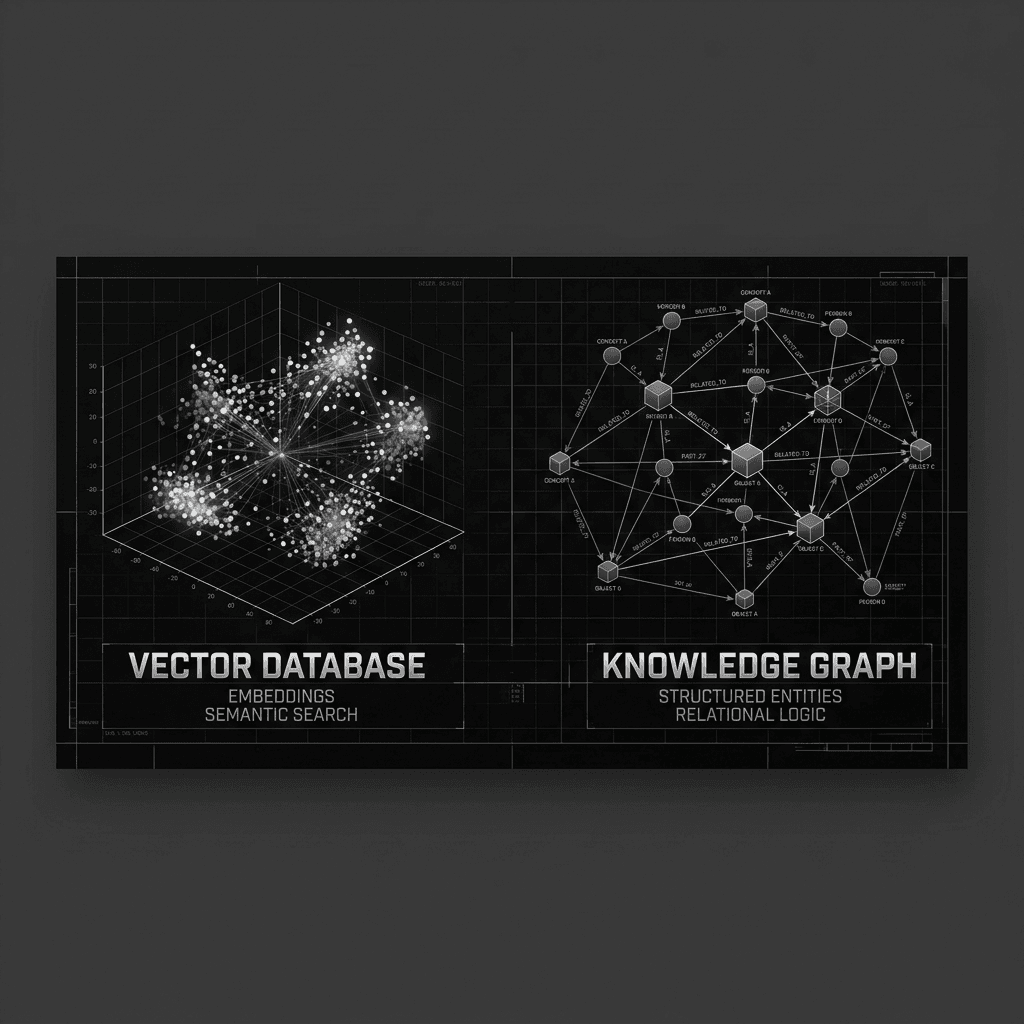
In our previous article, we explored the fundamental differences between Vector Databases and Knowledge Graphs, emphasizing the importance of “memory” design for AI agents. Today, we will focus on Hybrid RAG (Retrieval-Augmented Generation) architectures that combine the strengths of these two technologies in enterprise systems.
When Large Language Models (LLMs) operate on corporate data, they are expected to deliver not just “semantic similarity” but “deterministic accuracy”. It is unacceptable for a customer support bot or financial audit agent to give an “approximate” answer. This is where Hybrid RAG comes into play.
The Limits of Pure Vector RAG in Enterprise Systems
Vector databases (like Pinecone, Qdrant, Milvus) convert text into mathematical embeddings and perform semantic search. They work wonderfully for general concept questions like “What is the company’s leave policy?”.
However, consider asking this question: “What are the hardware specifications of the product purchased in Q3 by our highest-grossing customer last year?”
A Vector RAG system usually fails here because:
- The information is spread across multiple documents or database tables (Customer records, sales data, product PDFs).
- Semantic similarity cannot preserve relational links (Company A -> purchased -> Product B).
- Multi-hop reasoning is required.
The Solution: Hybrid RAG (Vector + Knowledge Graph)
Knowledge Graphs store data as entities and the relationships between these entities (e.g., Neo4j). Hybrid RAG combines semantic flexibility (Vector) and relational precision (Graph) in the same architecture.
How the Architecture Works
-
The Ingestion Phase:
- Corporate documents (PDFs, Wikis) are processed through LLMs.
- Entities (People, Products, Companies) and the connections between them are extracted from the document and written to the Graph Database.
- The plain text chunks of the same document are converted into embeddings and written to the Vector Database. (These two systems are connected via IDs).
-
The Retrieval Phase - Graph RAG:
- When a user asks a question, the system first identifies the “entities” in the question.
- These entities are searched within the knowledge graph, and the sub-graph between them is extracted. (This is a deterministic and exact set of relationships).
- Simultaneously, a semantic search is performed in the Vector Database.
- The “hard facts” from the Graph and the “general context” from the Vector are fed together into the LLM as a prompt.
The Future of Enterprise RAG
As of 2026, many Fortune 500 companies have begun replacing projects that rely solely on Vector search for internal documentation with Graph-RAG architectures. The most viable enterprise-grade way to prevent LLMs from hallucinating (making up non-existent data) is to provide them not just with “similar texts”, but with cryptographically provable “webs of reality” (knowledge graphs).
Your enterprise data isn’t just made of words; it consists of a complex web of relationships between your customers, employees, and products. The memory of your AI agents should reflect this reality.