
Before Artificial Intelligence: The Long Road to Thinking Machines
Explore the prehistory of AI - from formal logic and automata to punched cards, Babbage, Ada Lovelace, George Boole, and the first robots.
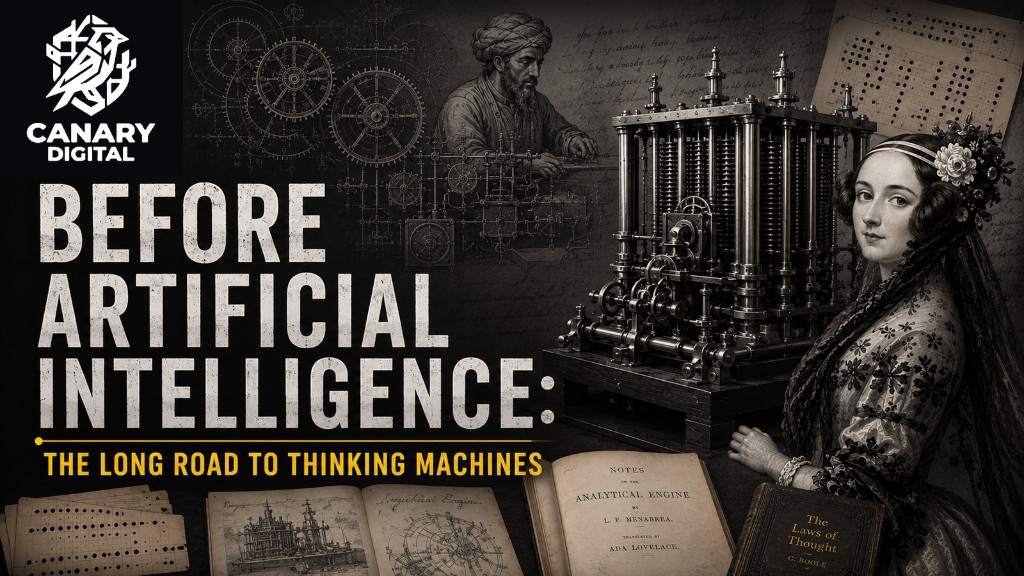
AI did not begin with ChatGPT, neural networks, or even electronic computers. Its deepest roots lie in formal logic, mechanical automata, punched cards, and the unfinished dream of a programmable machine.
Introduction: AI Has More Than One Beginning
When people tell the history of artificial intelligence, they often begin in 1956, when a small group of researchers met at Dartmouth College and gave the field its enduring name. Others begin in 1950 with Alan Turing, in 1943 with the first mathematical model of an artificial neuron, or in 2022 with the public arrival of ChatGPT. Each starting point is useful. None is complete.
The deeper history of AI is not the history of one invention. It is the convergence of several old ambitions: to describe reasoning as a system of rules, to build machines that perform sequences of actions, to separate instructions from the mechanism that carries them out, and to imagine artificial beings that might work, speak, create, or rebel. Long before anyone could train a neural network, people were already asking whether intelligence could be represented, reproduced, or mechanized.
That does not mean an ancient automaton was an AI system, or that a nineteenth-century calculating engine was a primitive chatbot. Treating every clever machine as “early AI” creates a false, inevitable march toward the present. The more useful approach is to identify the conceptual ingredients that later became part of artificial intelligence. The story begins with three of them: formal reasoning, programmable behavior, and cultural imagination. [1][2]
A history built around a single founding date also hides the fact that different parts of AI came from different disciplines. Logic contributed methods for representing inference. Mechanical engineering contributed control and repeatable action. Mathematics contributed abstraction. Literature contributed images of artificial workers and independent machines. Later, neuroscience, statistics, psychology, linguistics, and computer engineering would add their own questions. The result was not one continuous tradition but a meeting of traditions that had developed for different reasons.
This chapter therefore uses genealogy rather than origin mythology. It does not claim that every earlier thinker was secretly working toward AI. It asks a narrower question: which concepts became reusable when twentieth-century researchers began constructing machines that could reason, learn, perceive, and communicate? That distinction prevents hindsight from turning history into destiny.
1. From Myth to Mechanism
Stories of artificial life appear across many cultures. They include animated statues, mechanical servants, talking heads, and beings assembled by human hands. These stories are not engineering blueprints, but they matter because they reveal a persistent human desire: to create an artifact that behaves as if it possesses intention. The same stories also contain warnings. Artificial servants may exceed their purpose. A manufactured worker may threaten the social order. A machine may imitate life without sharing human judgment or responsibility.
For a history of AI, mythology is best treated as cultural prehistory rather than technical ancestry. The crucial shift occurs when imagined agency becomes a repeatable mechanism. Automata built for courts, temples, clocks, and public spectacles used water, weights, gears, valves, and carefully arranged sequences to create the appearance of purposeful behavior. The intelligence was not inside the machine. It was in the designer’s arrangement of causes.
That distinction remains important today. A system can produce a convincing performance without possessing the capacities observers attribute to it. Modern language models generate fluent responses; early automata produced lifelike motion. In both cases, human audiences tend to infer an inner agent from an outward display. The technologies are radically different, but the psychological temptation is familiar.
The boundary between spectacle and engineering was often deliberately blurred. A successful automaton was valuable partly because observers could not immediately see the chain of causes behind its motion. Hidden pipes, weights, cams, and operators made an artifact appear self-directed. The effect depended on both mechanism and interpretation. This is an early version of a problem that remains central to AI communication: a demonstration can reveal genuine capability while concealing the scaffolding, constraints, and human preparation that make the performance possible.
The lesson is not that a court automaton and a modern model are equivalent. It is that audiences evaluate unfamiliar systems through behavior. When the internal process is difficult to inspect, performance becomes a proxy for understanding. The history of artificial intelligence repeatedly turns on the gap between what a system does, how it does it, and what observers conclude from the display.
2. Al-Jazari and the Engineering of Programmed Performance
In 1206, the engineer Ismail al-Jazari completed a richly illustrated book describing clocks, water-raising devices, fountains, vessels, and mechanical figures. His machines belonged to a long tradition of automata, but his work was exceptional for its practical detail. He documented mechanisms in a way that made construction, adjustment, and maintenance visible rather than mysterious. [3][4]
Among the most famous designs were mechanical musicians whose behavior could be altered by changing the placement of pegs or cams. It is tempting to call such a system programmable. The word should be used carefully: the machine did not interpret a general-purpose language, store symbolic instructions, or learn from experience. Yet its behavior could be configured by changing an external pattern that controlled a sequence of actions. That is an important conceptual step.
Al-Jazari’s work also reminds us that the history of intelligent machines is not exclusively European and did not begin with industrial computing. Practical knowledge moved across regions and generations through manuscripts, workshops, instruments, and courtly engineering traditions. AI history becomes more accurate when it is connected to the wider history of mechanisms, control, and human efforts to reproduce organized behavior.
His treatise is important for another reason: it treats complex machines as systems composed of understandable parts. Motion is transmitted, timing is controlled, and failures can be diagnosed. This practical systems perspective would later become essential to robotics, where intelligence depends not on one clever component but on the coordination of sensing, control, planning, actuation, energy, and physical design.
Al-Jazari should not be recruited into a simplistic story in which medieval automata inevitably lead to AI. His historical importance is richer. He represents a tradition of documented engineering in which behavior could be decomposed into mechanisms and then reconstructed. That habit of decomposition - turning an effect into components, states, and sequences - is one of the habits from which computational thinking grows.
3. Turning Arithmetic into Machinery
The seventeenth century brought a new confidence that formal operations could be embodied in machines. Blaise Pascal developed a mechanical calculator in the 1640s to assist with repetitive arithmetic. Its wheels and carry mechanism could perform addition and subtraction. Gottfried Wilhelm Leibniz later designed a stepped reckoner intended to extend mechanical calculation to multiplication and division. [5]
Neither device was intelligent. Neither could choose a problem, change its method, or represent knowledge about the world. Their importance lies elsewhere: they separated the reliability of an operation from the attention of a human operator. Once a mechanism was designed correctly, arithmetic could be repeated through physical state changes.
Leibniz’s wider intellectual ambition was even more consequential. He imagined a formal language in which disputes might be resolved through calculation. The dream was not simply to automate numbers, but to formalize reasoning itself. That dream would remain far beyond the capabilities of mechanical calculators. Nevertheless, it anticipated a central project of symbolic AI: represent knowledge and inference so explicitly that a machine can operate on them.
This early history reveals a recurring pattern. First, a human activity is described as a sequence of formal steps. Then engineers build a mechanism that carries out those steps. Finally, observers ask whether expanding the mechanism could reproduce a larger part of intelligence. The distance between each stage is enormous, but the pattern repeats from mechanical arithmetic to theorem proving, machine translation, and modern AI agents.
Mechanical calculation also changed the status of error. Human arithmetic could fail because of fatigue, distraction, copying, or inconsistent procedure. A machine could fail because its design was incomplete, its parts were imprecise, or its mechanism was damaged. The source of reliability moved from the operator’s concentration to the artifact’s construction. That shift is still visible in AI systems: automation does not remove error; it relocates error into models, data, interfaces, assumptions, and deployment conditions.
Pascal and Leibniz also show why generality is difficult. A machine that adds numbers can be engineered around a known operation. A machine that reasons about arbitrary situations must represent an open-ended world, select relevant facts, handle uncertainty, and revise its conclusions. The history of AI is partly the history of discovering how much additional structure is required when a formal operation becomes an intelligent task.
4. The Jacquard Loom: Instructions Outside the Machine
At the beginning of the nineteenth century, the Jacquard mechanism transformed patterned weaving. A sequence of punched cards controlled which threads were raised for each row of a design. Holes and solid areas acted as physical instructions. By changing the cards, the same loom could produce a different pattern without rebuilding its core mechanism. [6][7]
The loom was not a computer. It did not calculate new results from data, and it did not branch in response to changing conditions. But it demonstrated a powerful idea: the behavior of a machine could be determined by an interchangeable information-bearing medium. The pattern was no longer permanently embodied in the machinery. It could be stored, copied, edited, and reused.
This separation between mechanism and instruction is one of the deepest ideas in computing. The Jacquard loom gave it a visible, industrial form. The machine became a platform; the card sequence became a specific performance.
The social meaning was equally important. Automation did not arrive as a neutral technical improvement. It changed skill, labor, production speed, and control over work. The later history of AI would repeatedly reproduce the same questions: Which tasks are being formalized? Whose expertise becomes embedded in the system? Who owns the machine and the instructions? Which forms of labor are displaced, reorganized, or made invisible? AI history is not only a sequence of inventions. It is also a history of institutions and power.
The holes on a Jacquard card are sometimes described as a direct ancestor of binary code. The comparison is useful only at a high level. A hole and a non-hole provide discrete control states, but the loom did not implement the logic, memory, and conditional execution of a digital computer. The more defensible connection is architectural: information external to the mechanism selected a sequence of operations.
Punched cards also made instructions tangible. They could be inspected, duplicated, stored in sets, rearranged, and physically damaged. Programs would later become less visible as they moved into electronic memory, but the operational idea remained. A general system becomes useful because instructions specify a particular task. The same distinction now appears in AI between a pretrained model and the prompts, tools, policies, data, and workflows that shape what the model does in practice.
5. Charles Babbage and the Architecture of a General Machine
Charles Babbage initially worked on the Difference Engine, a specialized machine intended to calculate and print mathematical tables. The more radical project was the Analytical Engine, developed in designs beginning in the 1830s. It was conceived as a general-purpose mechanical computer, not a single-function calculator. [8]
The proposed machine included a “store” for numbers and a “mill” for operations, concepts recognizable as ancestors of memory and a processing unit. It would use punched cards inspired by Jacquard technology to control operations and variables. Babbage’s plans included repeated operations and conditional behavior. The machine was never completed, but its architecture crossed an important threshold: one mechanism could, in principle, perform many different procedures depending on the instructions supplied. [8][9]
This is the point where the prehistory of AI becomes inseparable from the history of general-purpose computing. Intelligence cannot be reduced to computation, but software-based AI requires a machine whose function is not fixed at manufacture. A chess program, a language model, and an image generator can run on related computing infrastructure because the hardware is general and the instructions are changeable.
Babbage’s project was too complex, expensive, and mechanically demanding for its time. That failure is part of the story, not a footnote. AI history is full of ideas that became influential before they became practical. A design can define a research direction even when the available materials, precision, energy, data, or capital cannot yet realize it.
The Difference Engine and Analytical Engine are often merged in popular retellings, but the distinction matters. The Difference Engine was designed around a class of numerical calculations. The Analytical Engine was an attempt to create a machine whose operations could be rearranged to solve different problems. Generality moved from the inventor’s workshop into the architecture itself.
Babbage’s design also introduced organizational questions that modern computing still faces. Data had to be represented and stored. Operations had to be sequenced. Intermediate results had to be preserved. Instructions had to control both the movement of values and the choice of operations. The challenge was no longer merely making gears calculate; it was coordinating a complete information-processing system.
Because the Engine remained unfinished, historians must separate design capability from demonstrated performance. Plans can reveal a powerful architecture, but they do not prove that a full implementation would have operated reliably at scale. This distinction is equally important in modern AI, where architectural proposals, benchmark prototypes, and robust products are different stages of evidence.
6. Ada Lovelace and the Meaning of Programming
Ada Lovelace understood that the Analytical Engine represented more than faster arithmetic. In 1843, she published a translation of an account of the machine together with extensive notes. One of those notes described a procedure for calculating Bernoulli numbers, often identified as the first published algorithm intended for a general-purpose machine. The Science Museum also notes the need for historical precision: Babbage had developed algorithms in his own notebooks, and Lovelace’s work belonged to an active collaboration rather than an isolated act of invention. [10][11]
Her most important insight was conceptual. If entities such as musical notes or symbols could be represented through formal relations, the engine might manipulate them according to rules. A computing machine could therefore operate on representations, not merely on quantities understood as numbers. That idea is fundamental to modern computing and AI. Text, images, audio, code, and scientific structures become machine-processable when they are encoded in forms on which operations can be performed. [2][8]
Lovelace also articulated a limit. The engine, in her account, did not originate its own purposes; it executed relationships and operations supplied by people. A century later, Turing would discuss this position as “Lady Lovelace’s objection.” The debate is still alive. When a generative system produces an image, a proof strategy, or a melody, is it merely recombining relations learned from data, or does the process deserve a stronger concept of creativity?
The history does not settle the philosophical question. It shows that the question existed before electronic computers. Lovelace belongs in AI history not because she predicted a modern neural network, but because she recognized that programmable machines would transform symbols - and because she distinguished impressive output from independent agency.
The phrase “first programmer” is useful as an introduction but incomplete as a historical conclusion. Programming emerged gradually through the design of procedures, notation, machine control, and collaboration. Lovelace’s published table was significant because it explained how a complex operation could be organized for a general machine and communicated to readers. Babbage’s earlier work shows that authorship cannot be reduced to a single ceremonial title. [10][11]
Her discussion of symbols is especially relevant to AI because intelligence systems operate on representations. A machine does not receive a poem, a face, or a molecule in the way a person encounters one. It receives encoded structures: tokens, numerical arrays, graphs, signals, or other formal objects. The usefulness of the system depends on how those representations preserve relationships that matter for the task. Lovelace did not define machine learning, but she identified the conceptual bridge from physical calculation to general information processing.
Her limitation was also methodological. A machine’s surprising output should be explained through its operations, inputs, and design rather than treated as evidence of an unexplained inner mind. Modern systems complicate the argument because learned models contain patterns not individually specified by programmers. Even so, the demand for explanation remains: novelty in output does not by itself settle questions about intention, authorship, or understanding.
7. George Boole and the Algebra of Reasoning
While Babbage and Lovelace explored programmable machinery, George Boole pursued another essential ingredient: the mathematical representation of logic. In 1847, Boole introduced an algebraic system for expressing logical relations. He transformed parts of reasoning into operations that could be manipulated with mathematical symbols. [12]
Boole was not designing electronic circuits or AI software. Those applications came much later. His significance is that logic acquired an algebraic structure. Statements could be represented, combined, and evaluated according to formal rules. The later development of digital circuits would make Boolean operations physically executable, while symbolic AI would use formal languages to represent facts, rules, and deductions.
The connection between logic and AI has never been simple. Formal logic is powerful when the relevant concepts and rules can be stated precisely. Real environments are uncertain, incomplete, ambiguous, and constantly changing. Many AI systems therefore rely on probability, optimization, learned representations, or combinations of symbolic and statistical methods. Yet the logical ambition remains: describe a reasoning process clearly enough that it can be checked, executed, or automated. [1]
Modern AI has not replaced this tradition. Theorem provers, verification systems, knowledge graphs, rule engines, planning systems, and structured tool workflows continue to use its descendants. Even a neural model operating through tools must ultimately interact with formal interfaces: functions, schemas, permissions, conditions, and executable code.
Boolean logic later became fundamental to digital circuit design because electrical states could implement logical operations. But its importance to AI is broader than hardware. It encouraged researchers to treat reasoning as something with syntax, structure, and rules of transformation. Once a claim is represented formally, a machine may test consistency, derive consequences, or search for a proof.
The limitation is equally instructive. Intelligence in the real world rarely begins with perfectly defined symbols. A system must decide what objects exist, which categories apply, what evidence is trustworthy, and how to act when information is incomplete. Later AI traditions would address these problems with probability and learning. The continuing tension between explicit symbols and learned representations is one of the field’s oldest unresolved debates.
8. The Word “Robot” and the Politics of Artificial Workers
By the early twentieth century, industrial machinery had transformed work and urban life. In Karel Capek’s play R.U.R., published in 1920 and first performed in 1921, the word “robot” entered global culture. The term was connected to forced labor and drudgery; Capek credited his brother Josef with suggesting it. The artificial workers in the play were not metal machines in the modern sense, but manufactured beings created for labor. [13]
This origin matters because the robot was political before it was technical. The story asked what happens when humans create a class of artificial workers, define them only by productivity, and become dependent on their labor. The themes of replacement, control, autonomy, and rebellion were present from the beginning.
Today, “robot” and “AI” are often used as neutral labels for capabilities. Their history suggests a different reading. Intelligent automation is always introduced into an existing social arrangement. It changes bargaining power, responsibility, surveillance, access to expertise, and the distribution of benefits. The question is not only whether a machine can perform a task. It is also why the task is being automated, who decides the conditions, and who bears the errors.
The cultural imagination does not merely react to technology after it appears. It influences which projects receive attention, which risks feel urgent, and which futures appear desirable. From R.U.R. to contemporary stories about superintelligence, fiction provides the language through which societies interpret technical change.
The play’s robots were closer to manufactured biological workers than to metal machines, which is another warning against reading the past through present-day imagery. What survived was not the technical description but the social category: an artificial entity designed to perform labor.
That category shaped later expectations of robotics and AI. The ideal machine was often imagined as tireless, obedient, scalable, and cheaper than human labor. Such descriptions can make the human work around automation disappear - the people who design the system, label data, maintain equipment, correct outputs, absorb failures, and reorganize their jobs around the tool. The origin of “robot” reminds us that labor is not an accidental side issue in AI history. It is built into the language of the field.
9. What the Prehistory of AI Actually Gave Us
The period before electronic computing did not produce artificial intelligence. It produced the intellectual and mechanical conditions that made AI thinkable.
First, formal logic suggested that at least some reasoning could be represented as rules and operations. Second, automata demonstrated that complex sequences of behavior could be generated by mechanisms. Third, mechanical calculators showed that formal operations could be executed reliably outside the human mind. Fourth, punched cards separated instructions from the machine that followed them. Fifth, the Analytical Engine established the architecture of a general-purpose programmable device. Sixth, Lovelace expanded the meaning of computation from arithmetic to symbol manipulation. Finally, stories of robots framed intelligent machines as social actors whose labor, autonomy, and power would matter.
These ingredients did not combine automatically. The next century still required a theory of computation, electronic hardware, stored programs, information theory, mathematical neurons, learning algorithms, data, and enormous computing resources. Historical progress was not a straight line. Ideas were forgotten, rediscovered, reinterpreted, and often credited too narrowly.
This is why the prehistory of AI is more than a collection of curiosities. It reveals the assumptions that still shape the field. We continue to ask whether intelligence is primarily rule-following, learning, representation, embodiment, or social interaction. We continue to confuse performance with understanding. We continue to build general platforms that acquire their function from instructions and data. And we continue to debate whether machines extend human agency or compete with it.
It also gave us a warning about categories. A mechanism can be programmable without being general. It can be general-purpose without being intelligent. It can produce lifelike behavior without perception, learning, or agency. Clear historical distinctions help us describe modern systems more accurately. They prevent the word “AI” from becoming a label for every form of automation and prevent impressive outputs from erasing the infrastructure that produces them.
The prehistory therefore functions as a conceptual toolkit. It teaches us to ask where instructions reside, what is represented, which operations are automatic, how behavior is controlled, what kind of generality is claimed, and which human decisions remain outside the machine. Those questions will guide the rest of this series.
Conclusion: The Question Before the Technology
Artificial intelligence did not begin when a machine first appeared intelligent. It began whenever people tried to make reasoning explicit, behavior programmable, and symbols operational. The machines of al-Jazari, Pascal, Jacquard, and Babbage belonged to different worlds and served different purposes. Aristotle, Leibniz, Lovelace, and Boole were not members of a single research program. Their work becomes part of AI history only when we look backward and see how later technologies combined their ideas.
That backward view must remain disciplined. The Jacquard loom was not an early neural network. The Analytical Engine was not a Victorian large language model. Lovelace did not foresee ChatGPT in detail. What they contributed was more fundamental: a vocabulary of mechanisms, instructions, representations, and limits.
The next chapter begins when these ideas meet modern computation. In the 1930s and 1940s, Alan Turing, Claude Shannon, Norbert Wiener, Warren McCulloch, Walter Pitts, and others would turn the old dream of mechanical reason into a scientific program. The question would no longer be only whether humans could imagine a thinking machine. It would become whether mathematics, electronics, and experiments could build one.
The most durable inheritance is not a single device. It is a method of turning vague ambitions into operational questions. What counts as a rule? How is an instruction encoded? Which part of a task can be repeated mechanically? What must remain flexible? How should symbols relate to the world? When does a performance justify a claim about intelligence?
Those questions will become sharper in the twentieth century. Formal computation will define what machines can calculate. Electronic circuits will make general machines practical. Mathematical neurons will provide a model of learning networks. Cybernetics will connect behavior to feedback and control. The prehistory ends not with an intelligent machine, but with the conceptual pieces waiting for a new technological substrate.
Continue the Series
Next: Alan Turing and the Foundations of Machine Intelligence.
Continue to Part 2 to explore how formal computation, artificial neurons, cybernetics, information theory and the imitation game transformed old ideas into a scientific research program.
Research Sources
- [1] Stanford Encyclopedia of Philosophy, “Logic and Artificial Intelligence.” https://plato.stanford.edu/archives/win2013/entries/logic-ai/
- [2] Science Museum, “Human machine.” https://www.sciencemuseum.org.uk/objects-and-stories/human-machine
- [3] National Geographic History, “Ismail al-Jazari, the Muslim inventor whom some call the father of robotics.” https://www.nationalgeographic.com/history/history-magazine/article/ismail-al-jazari-muslim-inventor-called-father-robotics
- [4] KAUST Museum of Science and Technology in Islam, technology collection on al-Jazari automata. https://museum.kaust.edu.sa/explore/technology/
- [5] Nils J. Nilsson, The Quest for Artificial Intelligence: A History of Ideas and Achievements. https://ai.stanford.edu/~nilsson/QAI/qai.pdf
- [6] Science and Industry Museum, “The story of the Jacquard loom.” https://www.scienceandindustrymuseum.org.uk/objects-and-stories/jacquard-loom
- [7] Smithsonian National Museum of American History, “Punch Cards.” https://americanhistory.si.edu/ne/collections/object-groups/punch-cards
- [8] Science Museum, “Charles Babbage’s Difference Engines and the Science Museum.” https://www.sciencemuseum.org.uk/objects-and-stories/charles-babbages-difference-engines-and-science-museum
- [9] Science Museum Group Collection, “Punched cards for Babbage’s Analytical Engine.” https://collection.sciencemuseumgroup.org.uk/objects/co62248/punched-cards-for-babbages-analytical-engine
- [10] Science Museum, “Ada Lovelace: visionary of the computer age.” https://blog.sciencemuseum.org.uk/ada-lovelace-visionary-of-the-computer-age/
- [11] Science Museum, “Women in Computing.” https://www.sciencemuseum.org.uk/objects-and-stories/women-computing
- [12] Stanford Encyclopedia of Philosophy, “The Algebra of Logic Tradition.” https://plato.stanford.edu/archives/win2022/entries/algebra-logic-tradition/
- [13] Christopher Csikszentmihalyi, “An Engineer’s Nightmare: 102 Years of Critical Robotics.” https://arxiv.org/abs/2205.04831